



Case study JKET
JKET was an Italian e-commerce of monthly mystery boxes containing Japanese sweets, delivered to home. We built it in two (a designer and a developer) in 2015, before the monthly subscription box model became a market in Italy. Live, with the first hundred pre-orders collected, it closed in 2017 due to operational and fiscal difficulties. It stays in the portfolio as a founder-built project that caught a market early, and that taught those who built it that seeing first isn't enough.
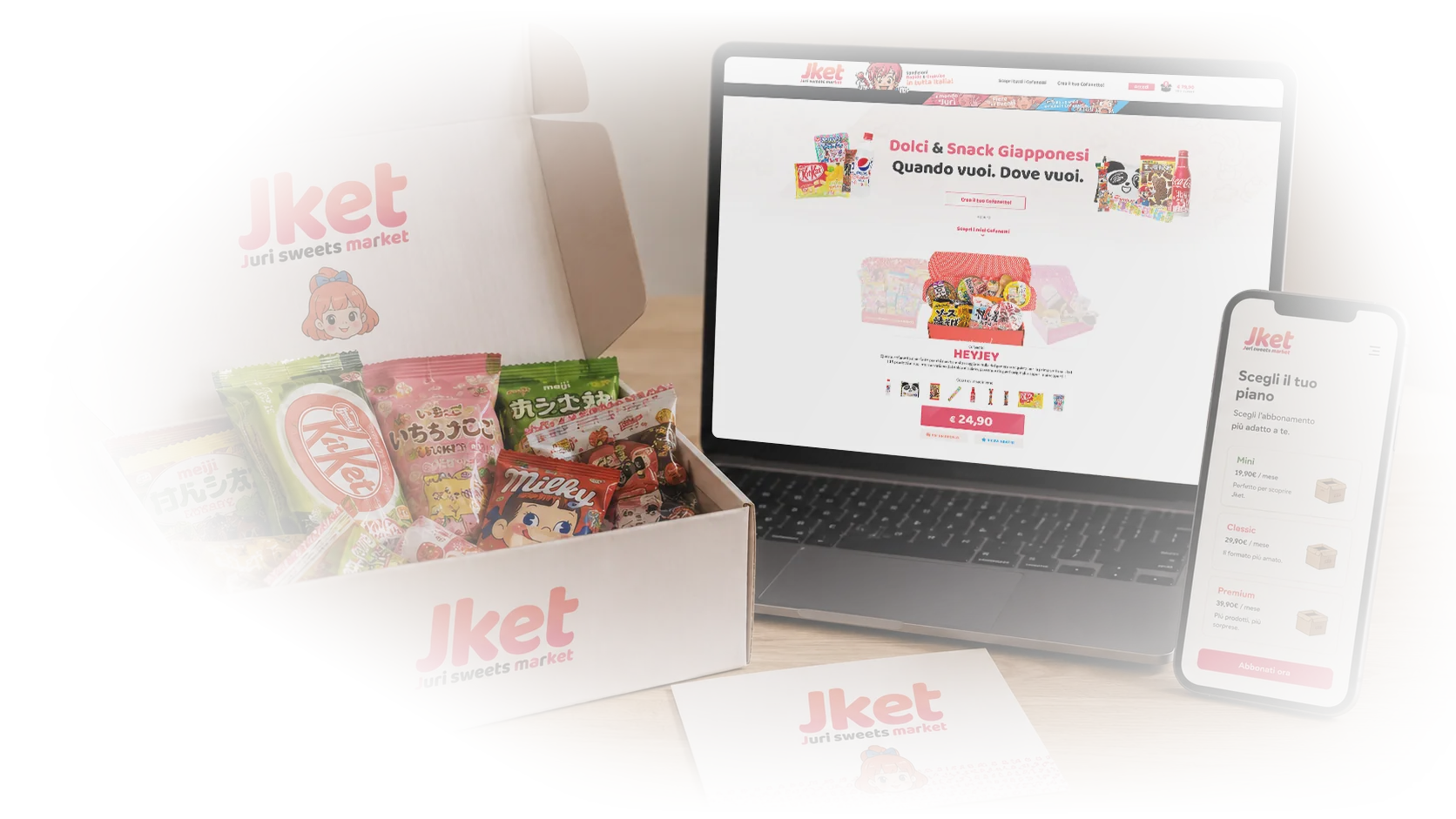
Building a mystery box before it was a market
In 2015, monthly subscription boxes were not yet a market in Italy. In the United States the first players had started taking shape (Birchbox for cosmetics, Loot Crate for merchandise), but in Italy the model was unknown: nobody was shipping monthly surprise packages home. Japanese culture was widespread among anime, manga, and Japanese cuisine enthusiasts, but anyone who wanted to try Japanese sweets had to go to a physical store in major cities or order individually from international retailers.
JKET was born on a simple intuition: bring the ritual of the Japanese surprise box to Italian consumers, with a curated selection that changed every month. We built it in two (a designer and a full-stack developer) starting from the idea and arriving at the first box shipped.
The product: one box a month, never identical
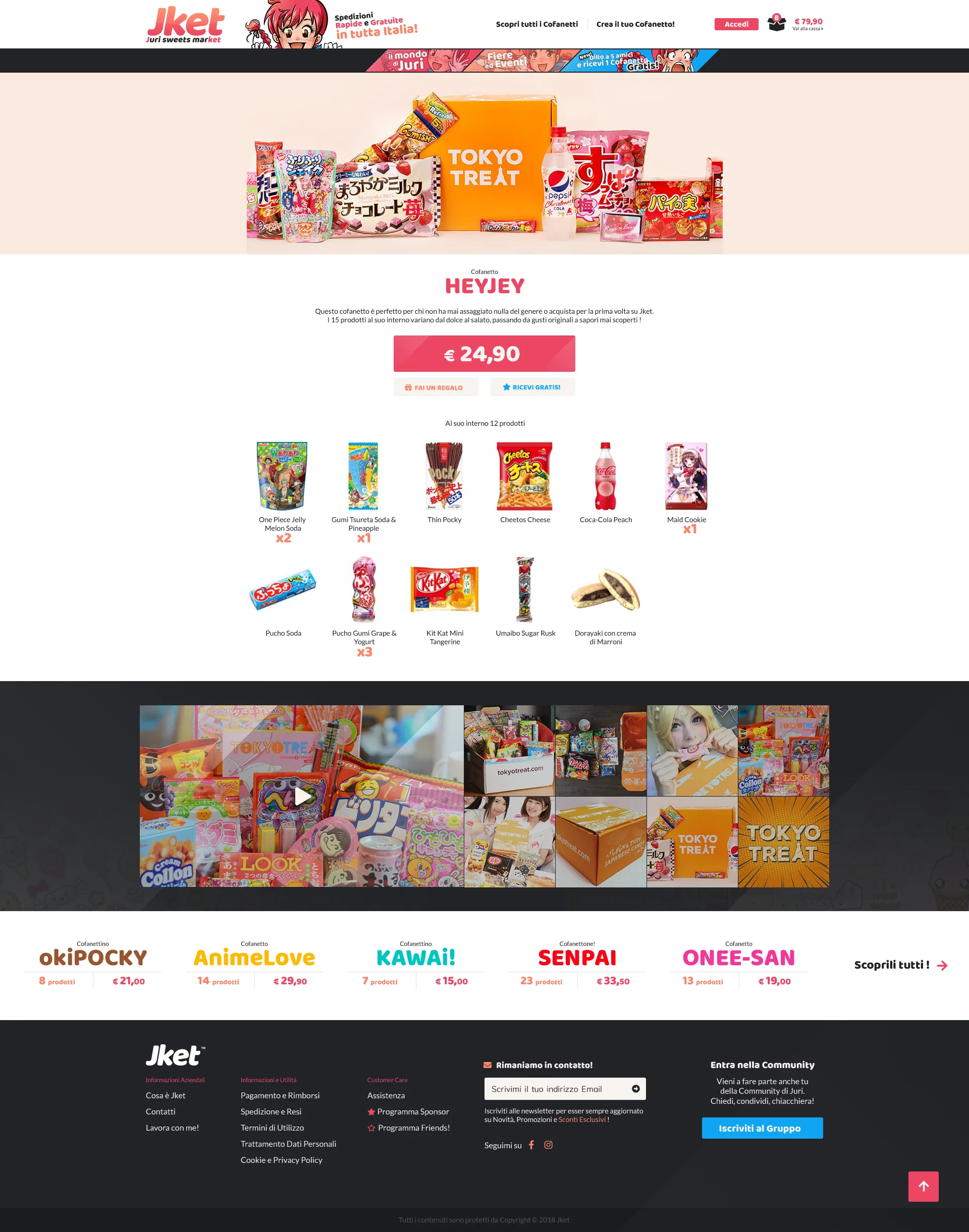
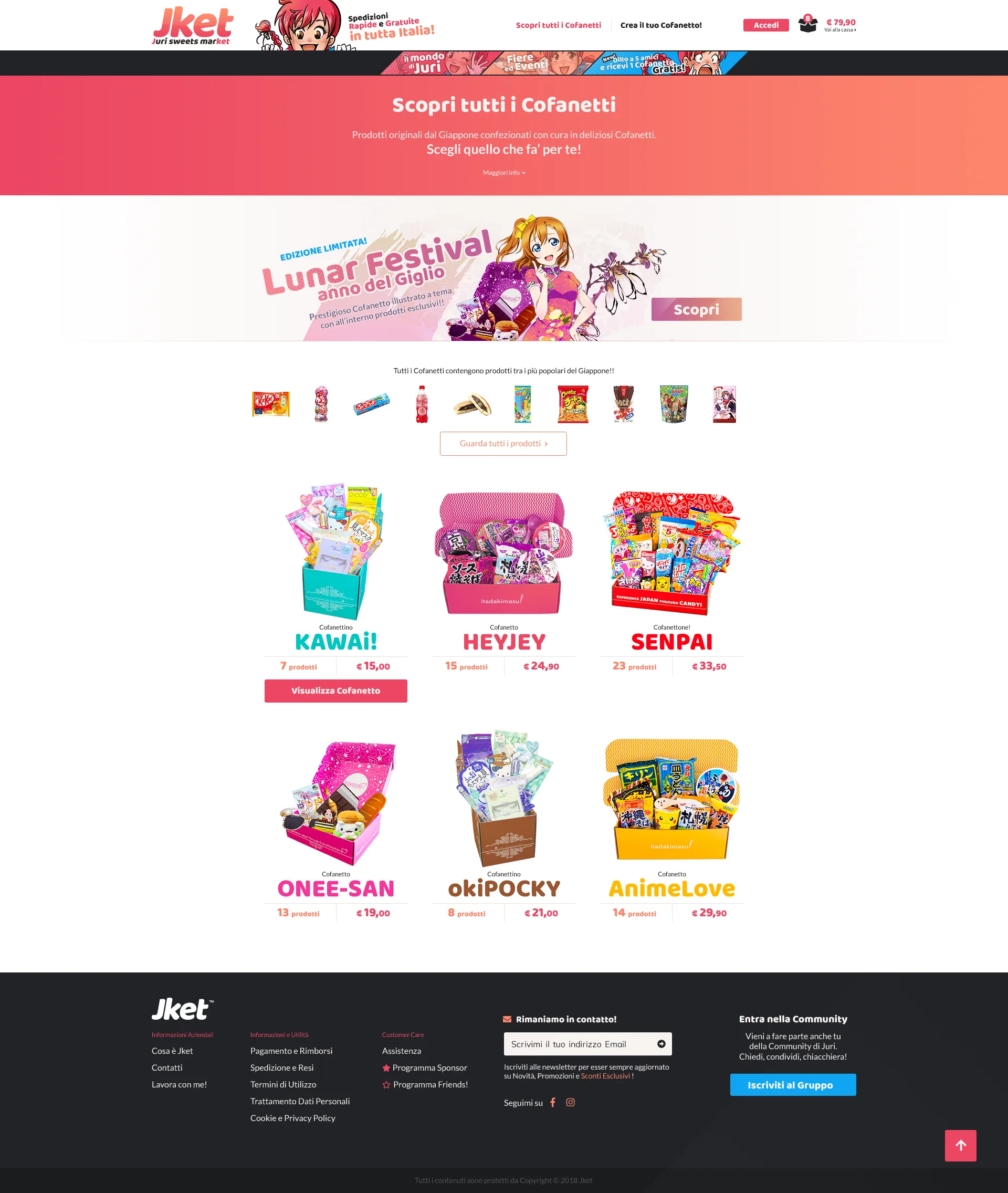
JKET wasn’t an online shop of Japanese products. It was a monthly selection service. Each month a different curation, each box a self-contained experience: traditional wagashi, modern snacks, seasonal sweets, beverages, small cultural objects. Multiple formats at different price tiers, with the same curatorial logic at the base.
The customer subscribed to a monthly subscription, received the box at home in the first days of the month, and waited for the next. No catalog to browse, no “pick your products”: the surprise was part of the value. JKET’s promise wasn’t “buy Japanese products”, it was “receive a small Japan at home, every month”.
The site: two people, full-stack, handmade
JKET.com was built by two. A designer for everything that wasn’t code (interface, brand, product photography, editorial content, marketing) and a full-stack developer for the site and e-commerce. No Shopify, no pre-packaged drag-and-drop platforms: it was still the era when real products were built by hand, and in 2015 subscription commerce platforms weren’t yet mature.
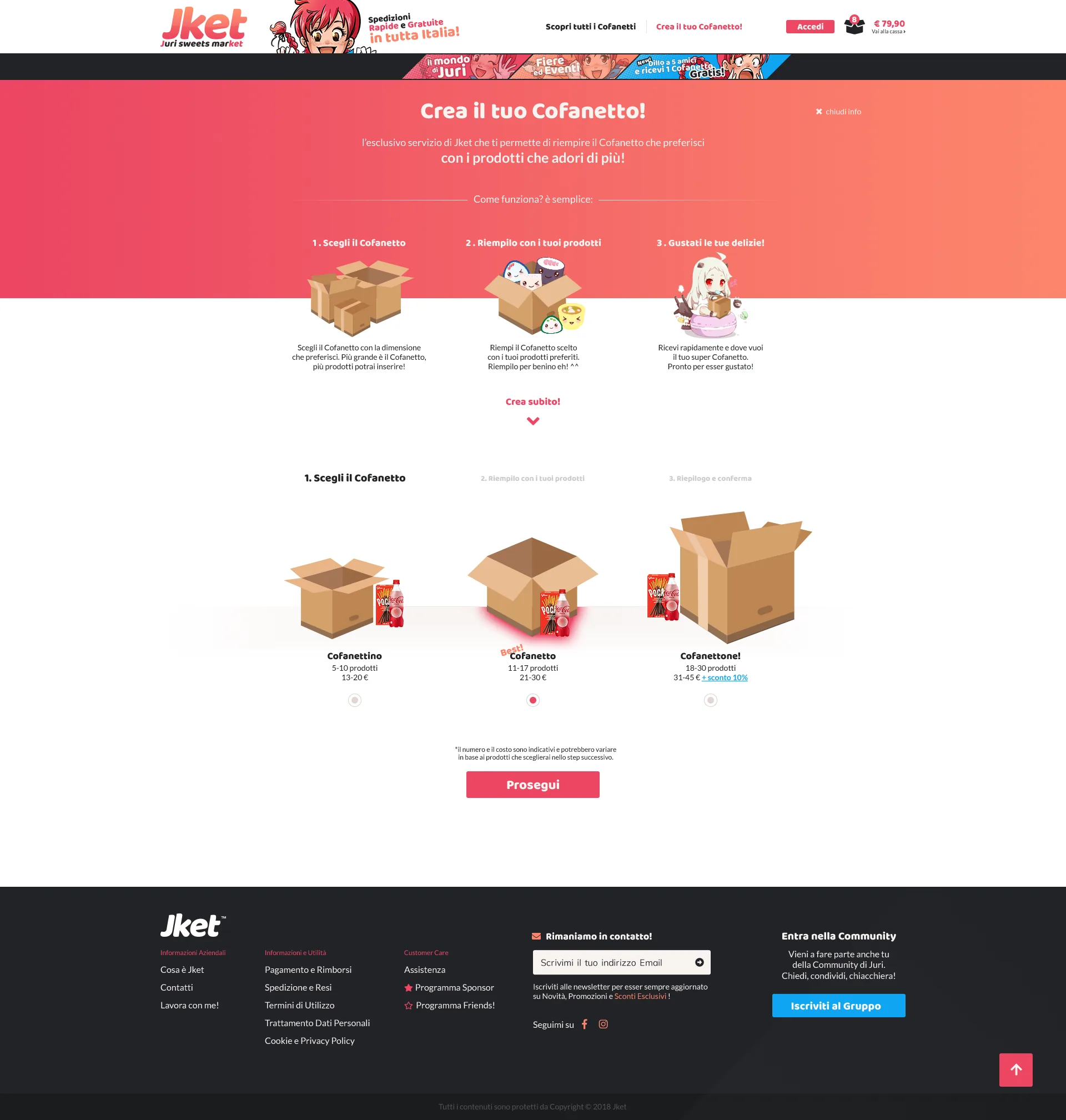
The site had an essential structure: editorial home with the current month’s box, subscription page with available formats, archive section of already-shipped boxes, customer area to manage one’s subscription. Nothing more, nothing less. The promise was readable in thirty seconds: choose the format, subscribe, receive.
JKET = Juri's Market
JKET isn’t the name of a startup. It’s the acronym of Juri’s Market, and Juri Harada was the mascot of the ecommerce: the branding that gave it a face, a world, a point of view.
Juri is a twenty-year-old historical researcher who lives in the year 3099 in Tokyo3 (a cloned city in a post-Cultural-Boom era) and travels through time to bring back retro objects from past eras: sweets, manga, music, videogames. Red-orange hair, freckles, hazel eyes, blue ribbon around her neck. Her shop is called J’sMarket.
The character and the ecommerce were built as functions of each other. The character gave the product a world to inhabit, a voice, a narrative motivation: each box was a “Juri find” brought from Japan. The product gave the character a real place: the shop was invented, but the boxes we shipped were real.
Inside the same universe, the designer of the shop is called “G”, an anti-conformist Italian who lives in Londra1 and arrives in Tokyo3 every weekend to help Juri with the market’s design. G is the alter ego of the real designer inside Juri’s world. Two roles facing each other in a mirror.
One hundred pre-orders, before the market was a market
JKET generated about one hundred pre-orders in its initial months, a small number in absolute terms, but significant for two reasons.
First: it proved the market existed. There were Italian customers willing to pay to receive a monthly selection of Japanese sweets at home without being able to choose individual products, trusting the curation. Second: it proved it before the model was a market in Italy. Japanese product subscription boxes arrived on the Italian market in the following years, when the model had already taken hold in the United States and Anglo-Saxon markets.
The product intuition was correct. The execution wasn’t.
What we hadn't foreseen
In 2017 JKET closed. Not for lack of market. The market was there, we had seen it. For a combination of reasons that to two people just starting out seemed solvable and were instead structural: the fiscal and customs complexity of an import-stock-sell operation in Italy, managed without a solid corporate structure; the rising cost of sourcing and logistics that beat unit revenue; the volume too small to absorb fixed costs, too large to handle as an evening hobby.
The closure was a lucid decision, not a sudden failure. We closed subscriptions, fulfilled remaining orders, returned what we owed. JKET stays in the portfolio as the case in which we caught a market early, and in which we learned that, alone, intuition isn’t enough.
Seeing first isn't enough. You have to know how to build after.
Numbers
1
Universe
Tokyo3, 3099
1
Real shop
JKET = J's Market
100+
Pre-orders
2015–2017
Have a similar project?
Let’s talk about the next project.
Performance & Interaction Design Studio. Every client followed personally, from brief to delivery.